 ReAct-GS

Abstract
3D Gaussian Splatting (3D-GS) achieves real-time photorealistic novel view synthesis, yet struggles with complex scenes due to over-reconstruction issue, manifesting as local blurring and needle-shaped artifacts. While recent studies attribute this to insufficient splitting strategy on large-scale 3D Gaussian primitives, we identify two fundamental limitations underlying this issue: gradient magnitude dilution during densification and the primitive frozen phenomenon, where necessary Gaussian densification is inhibited in complex regions and suboptimally scaled Gaussians become freezing in local optima. To address these challenges, we propose ReAct-GS, a method grounded in the principle of re-activation. Our approach introduces: (1) an importance-aware densification criterion that incorporates alpha blending weights from multiple viewpoints to reactivate stalled primitive growth in complex regions, and (2) a re-activation mechanism that revives frozen primitives through adaptive parameter perturbations. Extensive experiments across multiple real-world datasets demonstrate that ReAct-GS successfully eliminates over-reconstruction artifacts and achieves state-of-the-art performance on standard novel view synthesis metrics while preserving fine geometric details. Furthermore, our proposed re-activation mechanism shows consistent improvements when integrated with other 3D-GS variants such as Pixel-GS, validating its broad applicability.
Method
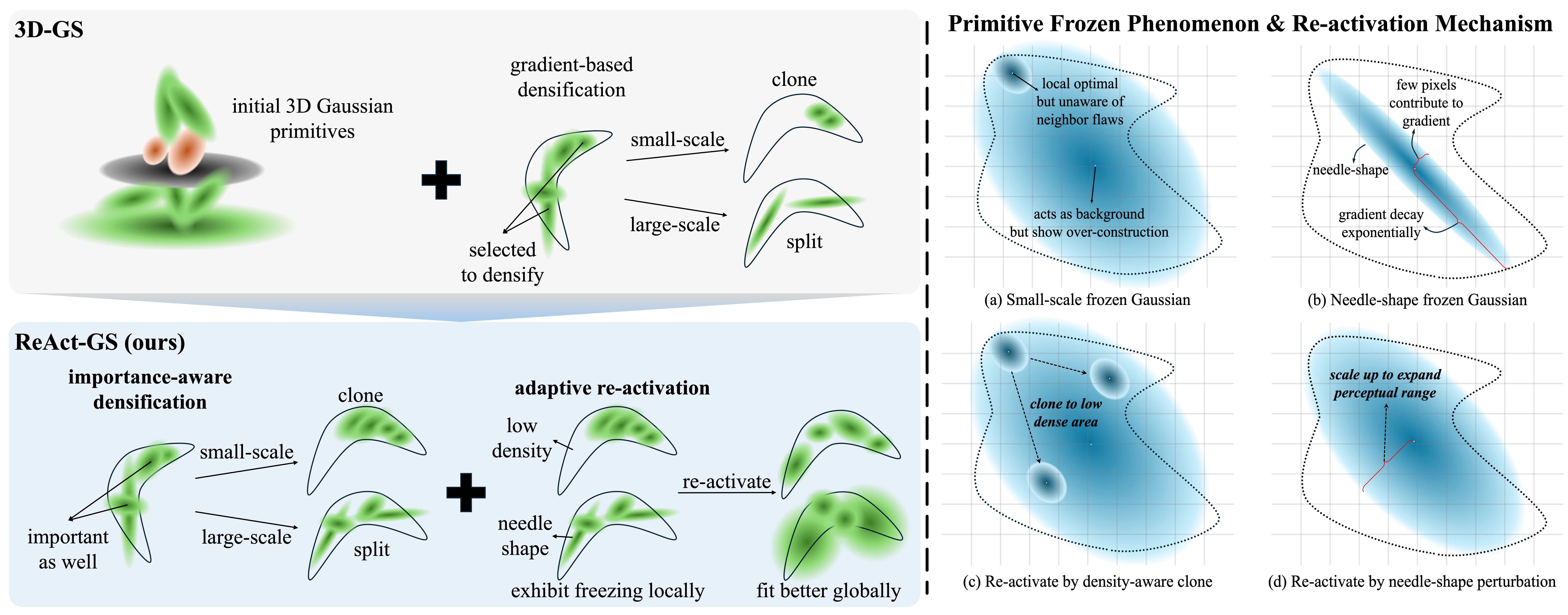
Key contributions of ReAct-GS. (Left) We identify the gradient magnitude dilution issue in the original average gradient densification criterion of 3D-GS. Instead, we propose importance-aware densification, which considers alpha blending weights in accumulated gradient magnitude, thus accurately identifying primitives that require densification to fit complex scenes. (Right) We also discover the primitive frozen phenomenon which causes persistent blurring and needle-shape artifacts. Accordingly, we propose a re-activation mechanism consisting of density-guided cloning and needle-shape perturbation, which comprehensively addresses over-reconstruction artifacts by strategically perturbing specific parameters of 3D Gaussians.